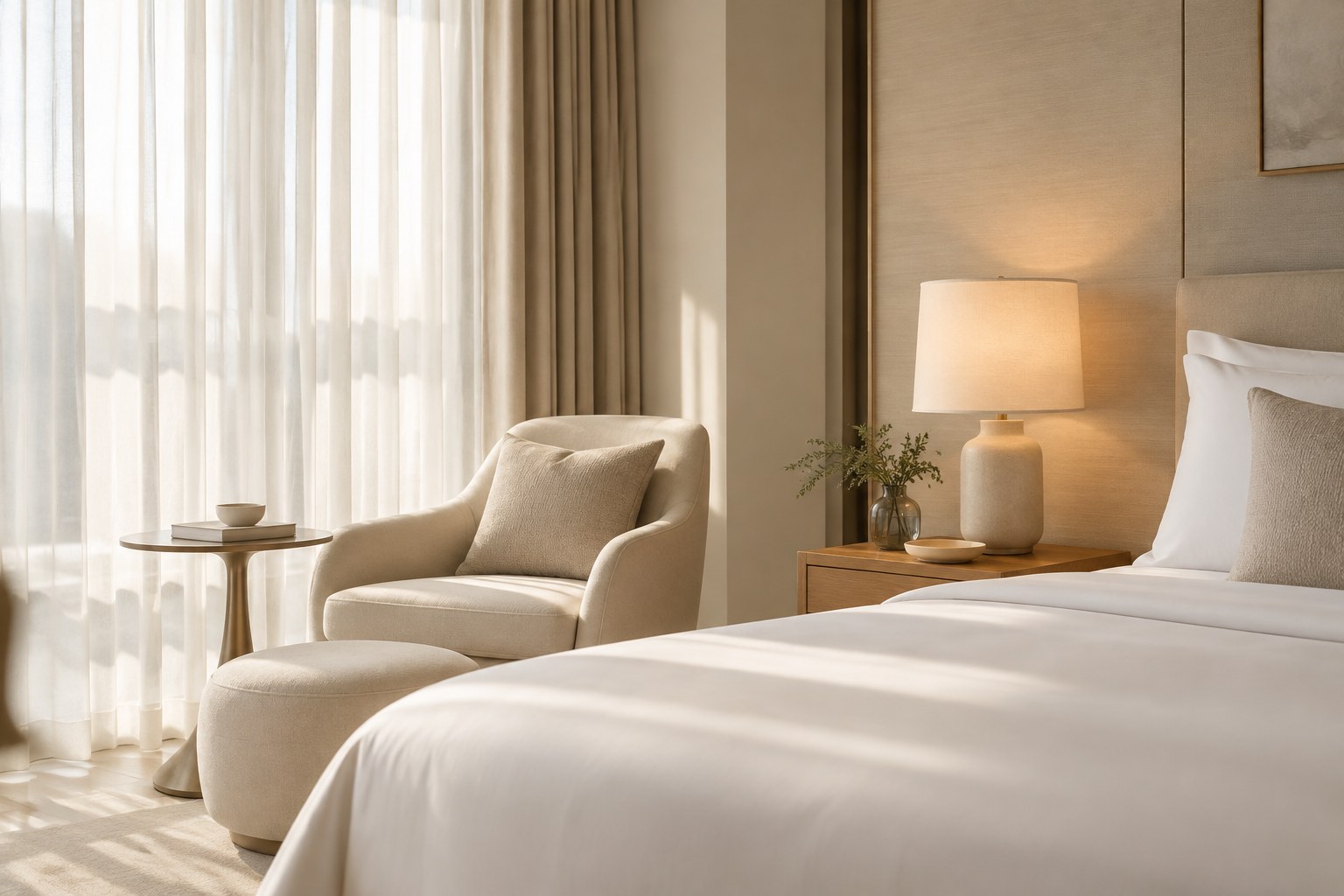
From digital keys to voice-activated room controls, hotels are embracing AI to deliver personalized experiences. Guests can set lighting scenes, request extra pillows, or order room service through their phones. While these conveniences are appealing, thoughtful design ensures they complement rather than replace human hospitality.
Key Ideas
- An AI concierge handles the routine, instant, and repeatable: recommendations, room controls, housekeeping requests, amenity questions. Staff keep the complex, emotional, and exceptional.
- The design risk is not the technology itself but where it lives in the room. Tech should be findable in seconds and invisible the rest of the time.
- Privacy is a design consideration, not just a legal one: visible controls, clear language, and honest opt-outs build the trust the system needs to be used.
- Start small and property-appropriate. The right first step differs for a boutique hotel versus a short-stay rental. These hospitality design trends show what guests increasingly expect the room itself to deliver.
The Rise of Digital Concierges
AI concierges are essentially chatbots trained to handle common guest requests. They can provide local recommendations and directions, adjust in-room lighting, temperature, and entertainment settings, schedule housekeeping or maintenance visits, and answer questions about hotel amenities. Guests appreciate the immediate response and the ability to customize their stay. For operators, these systems reduce call volume and allow staff to focus on more complex service.
The pattern worth noticing: guests do not want to talk to a machine. They want the thing the machine gets them, a warmer room, a faster towel, a good restaurant nearby, without friction. Design for the outcome, not the interface. The best-implemented systems are the ones guests barely notice: the room is already comfortable, the request took ten seconds, the human staff appeared exactly when a human was needed.
Maintaining Warmth in a Digital World
A fully automated experience can feel cold if not balanced with human interaction. To keep hospitality genuine: blend digital with personal by offering digital check-in but keeping staff in the lobby for greetings. Design intuitive interfaces with clear icons and simple language. Provide options for guests who are not comfortable with voice assistants. Respect privacy and be transparent about data collection. Infuse local flavor through artwork, materials, and decor that reflect the location.
Designers have a specific role here that technologists do not: deciding what the guest sees and touches. A voice assistant with no visible alternative excludes the guest who will not use one. A tablet bolted to the nightstand dominates a room designed for calm. Specify the physical layer, placement, materiality, fallback options, with the same care as the lighting. And treat data transparency as part of the guest experience: a short, plain-language note about what is collected and why does more for trust than a buried privacy policy. For the broader picture on what guest data flows through design tools, this look at confidentiality and AI in design workflows is a useful companion read.
Integrating AI Systems Into Boutique Properties
Smaller hotels and short-stay rentals may worry about the cost of high-tech systems. Start with scalable solutions: smart locks with mobile keys, simple room-control apps, or automated welcome messages. These features can differentiate your property without overwhelming staff. Make sure the systems integrate with your existing property management software to avoid duplicating work.
A sensible entry ladder, matched to property type:
| Property | Sensible first step | What to avoid |
|---|---|---|
| Boutique hotel (20–80 keys) | Mobile keys, messaging-based concierge, two or three lighting scenes | A different app for every function; guests will not download four apps |
| Short-stay rental | Smart lock, automated welcome and checkout messages, one simple room guide | Voice assistants with no mute or opt-out; renters did not choose your ecosystem |
| Luxury / lifestyle property | All of the above plus personalized pre-arrival preferences | Tech that fights the design narrative; a quiet-luxury room should not feel like a showroom |
Whatever the scale, standardize before you expand. One property running the same system in every room beats three properties each running something different. Staff can only support what they understand, and guests can only trust what behaves consistently.
Questions, Answered
Do guests actually prefer AI service over human service?
They prefer speed for simple things and humans for everything else. A 2 a.m. request for extra pillows is a machine's job. A complaint, a celebration, a complicated itinerary is a person's job. Properties that try to automate the second category learn quickly why it fails. Design the handoff: the system should know when to bring in a human, and the guest should never have to ask twice.
What about older guests or the less tech-comfortable?
Design for them first and everyone benefits. Every digital function needs a non-digital path: a phone number that reaches a person, a physical switch alongside the app control, printed instructions in plain language. If the room only works for a tech-comfortable thirty-year-old, the design has failed a large share of paying guests.
Does adding AI concierge tech reduce staffing needs?
It shifts staffing, rarely reduces it. Routine requests drop, which frees staff for the high-touch moments that actually drive reviews and repeat stays. Properties that cut staff after adding tech usually discover that the remaining team is now doing tech support on top of hospitality. Budget for both.
Enhance Your Guest Experience
An AI concierge can elevate comfort and convenience when implemented thoughtfully. At Creo, we support designers in incorporating technology into spaces while preserving human connection. If you are exploring AI for hospitality and need help translating concepts into detailed plans, reach out.
Ready to work with a studio that moves at your pace?
Get In Touch