Closing the 'Or Approved Equal' Trap Before It Becomes an RFI
The phrase shows up across most project specifications: or approved equal. It is meant to give contractors flexibility. In practice, it often creates the opposite — a gray zone where the cheapest available option gets submitted, the designer pushes back, and everyone spends time on a substitution review that should have been straightforward.
The issue is not the phrase itself. The issue is that most specs never define what equal actually means.
Why the Same Phrase Means Different Things to the Designer and the Contractor
When a spec names a product and adds or approved equal without further guidance, the contractor is left to interpret what qualifies. That interpretation is usually practical: find something that fits the budget and the schedule.
The designer's interpretation is usually different: find something that matches the design intent, the finish quality, the dimensional profile, and the performance standard of the specified product.
Neither party is wrong. The spec just did not give them a shared standard.
The result is a substitution request that requires back-and-forth to resolve, a potential pricing dispute if the substitution is rejected late, and sometimes a product installed in the field before anyone noticed the difference. Some of those back-and-forth exchanges become formal RFIs. Others stay informal but still consume time and create gaps in the project record.
What Equivalency Criteria Actually Do
Equivalency criteria are the specific conditions a substitute product must meet to qualify as an approved equal. They shift the review from a judgment call to a checklist.
Instead of asking is this good enough, the question becomes does this meet the stated criteria. That is a much easier conversation for everyone.
A substitution request that arrives with clear criteria attached can be reviewed quickly. One that arrives without them requires the designer to reconstruct the intent from scratch — and that is where the process slows down.
Criteria Worth Writing Into the Spec
Not every product needs the same set of criteria. A structural component has different review priorities than a decorative finish. But for finish materials, fixtures, hardware, and anything with a visible or performance role, these are the areas worth specifying explicitly.
The table below covers the five criteria categories most likely to matter for finish and fixture substitutions. Not every product needs all five — the point is to decide during spec writing which ones apply, rather than working it out during submittal review.
| Criteria | What to define |
|---|---|
| Performance | Load rating, flow rate, light output, acoustic rating, or other measurable function |
| Dimensions | Overall size, profile depth, mounting footprint, and critical clearances |
| Finish | Color, sheen level, texture, material composition, and finish durability |
| Warranty | Minimum warranty period and what it covers, where relevant to the product category |
| Design intent | Visual character, weight, detail scale, or other qualities that matter to the design |
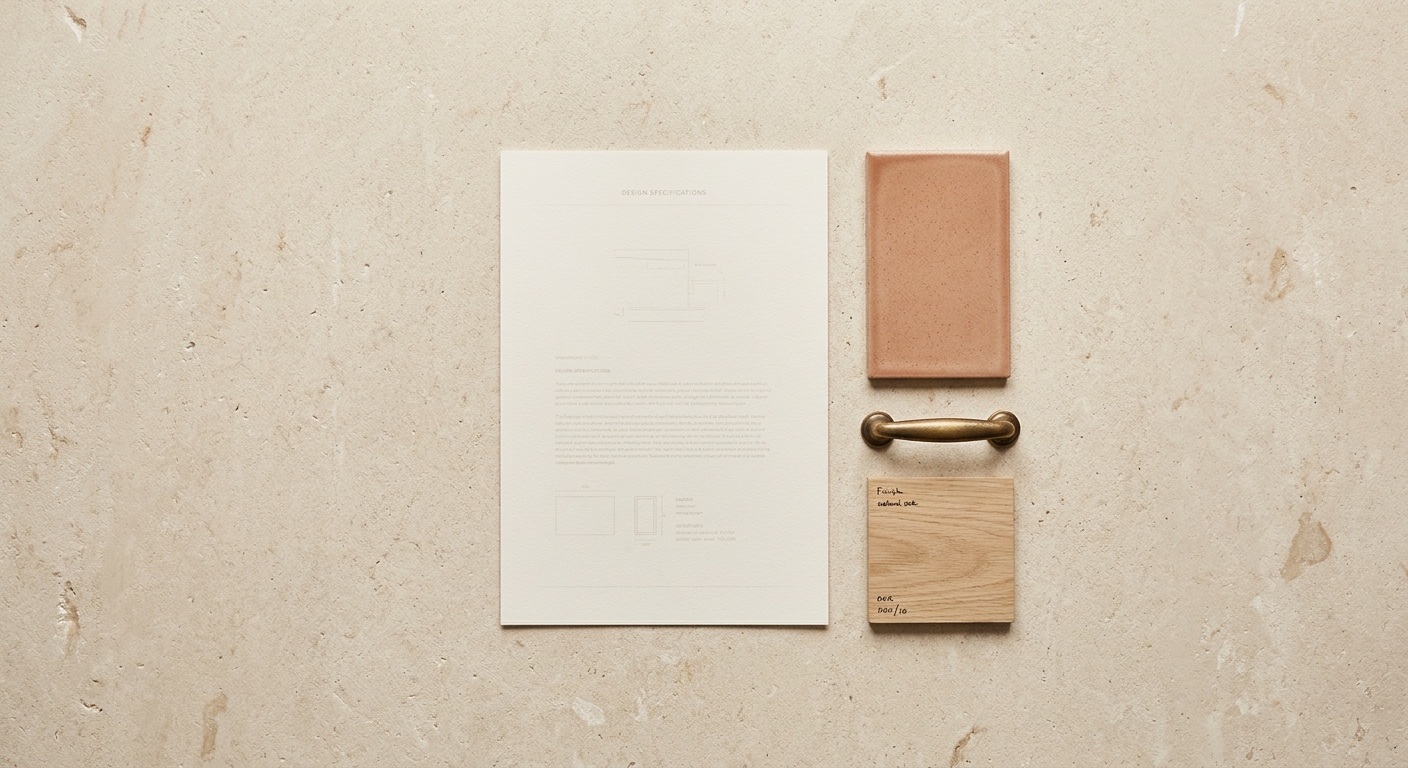
Design intent is the hardest to write and often the most important to include. A substitute tile may match the dimensions and finish category but have a surface texture that reads completely differently in the space. If the spec does not say anything about visual character, that substitution is technically defensible.
A short sentence is enough: Substitute must maintain the matte, low-variation surface character of the specified product. High-gloss or heavily veined alternatives will not be considered equal.
The same logic applies to fixtures and hardware. A substitute faucet may meet the flow rate and dimensional footprint but have a handle profile and finish weight that undercut the design intent. Without a written standard, that conversation happens at the submittal stage under time pressure — which is the wrong moment to be defining what the project actually requires.
A Common Mistake: Leaving the Criteria Out of the Spec Entirely
The most common version of this problem is not bad criteria — it is no criteria at all. The spec names a product, adds or approved equal, and moves on.
This puts the entire burden of interpretation on the substitution review process, which happens during construction when schedules are moving and decisions need to be fast. That is the wrong moment to be working out what the design intent actually requires.
The better approach is to write the criteria during the specification phase, when there is still time to think clearly about what matters and what does not. A few sentences per product section can reduce a significant amount of review friction later.
A Simple Review Framework for Substitution Requests
When a substitution request comes in, a quick structured review helps keep the process consistent.
Before accepting or rejecting:
- Does the submittal include the manufacturer's product data sheet?
- Does it address each of the stated equivalency criteria?
- Is the dimensional profile compatible with the surrounding conditions?
- Does the finish match the specified standard?
- Does the warranty meet the minimum requirement for this product category?
- Does the visual character support the design intent?
If the submittal does not address the criteria, send it back with a specific list of what is missing. That is faster than a full RFI and creates a cleaner record.
If the submittal addresses the criteria and the substitute qualifies, approve it with a note confirming which criteria were reviewed. That documentation helps if questions come up later about why a substitution was accepted.
What Happens When Substitutions Are Reviewable Instead of Negotiable
Substitutions are a normal part of construction. Products get discontinued, lead times shift, and budgets change. The goal is not to eliminate substitutions — it is to make them reviewable.
A spec that defines equivalency criteria gives contractors a clear target and gives designers a defensible standard. It reduces the number of substitutions that require extended back-and-forth, and it reduces the risk that a product gets installed before anyone realizes it does not meet the intent.
The practical takeaway is simple: decide what equal means before the project goes to bid, not after the substitution request arrives.
For remodelers and contractors who work regularly with design partners, having a shared substitution review process built into the project workflow can make this even smoother. Creo's contractor partnership model supports exactly this kind of documentation and production coordination — helping design and construction teams stay aligned before questions reach the field.
Ready to work with a studio that moves at your pace?
Get In Touch