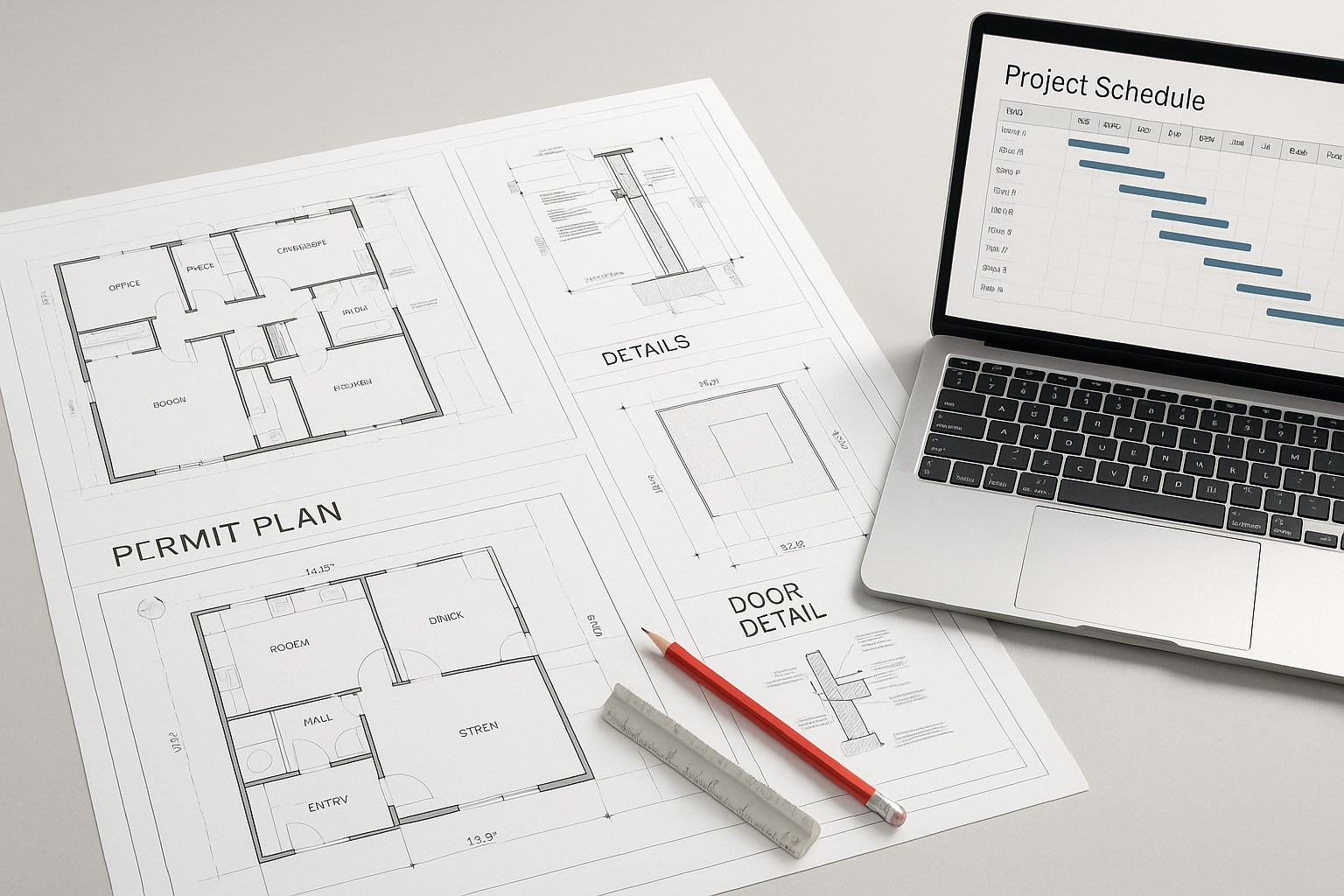
The buying problem nobody talks about
Small general contractors need design support constantly. Permit sets for remodels and additions. RFI responses during construction. Someone to review submittals, issue clarifications, and keep the drawing set current while the job moves. The need is real and recurring.
But buying that support is painful. The typical arrangement is hourly, open-ended, and defined by whatever the designer's proposal happened to say — which the GC skimmed, signed, and filed. Every invoice becomes a small negotiation, and the GC never quite knows what a permit set will cost until it is done.
So many small GCs do the rational thing: they avoid outside design support until they are forced into it. They draw their own permit sketches, answer their own RFIs, and absorb the cost of the rework that follows. The problem is not price. The problem is that buying design support feels like signing a blank check.
The fix is to stop selling hours and start selling packages: fixed-fee permit-set and construction-administration products with defined deliverables, defined boundaries, and a defined cadence. A menu the GC can read, price, and approve in one conversation.
What to know first
- Small GCs avoid design support because buying it feels like signing a blank check — not because they do not need it. Fixed-fee packages with clear boundaries remove that friction.
- Productizing means naming exactly what is included, the scope band, the timeline, and the fixed fee — plus explicit exclusions — before anything starts.
- Two starter packages cover most of the need: a permit-set package (drawings through plan-check corrections) and a construction-administration package (RFIs, submittals, site visits, bulletins on a set cadence).
- Boundaries protect both sides. When the package defines what counts as a correction round or a bulletin revision, scope creep becomes a change-order conversation instead of an argument.
What "productizing" actually means here
Productizing a service means packaging it so the buyer understands exactly what they get, what it costs, and where it ends — before anything starts. It is not a gimmick. It is the difference between "design support, billed hourly" and "Permit Set Package: $X, includes Y, delivered in Z weeks, with these exclusions."
For a small GC, that difference is everything. Contractors live on fixed bids — an open-ended hourly engagement is the one line item on their project budget they cannot control. A fixed-fee package with clear boundaries fits how they already buy everything else.
For the design firm, productizing standardizes delivery, makes scope creep visible the moment it happens, and turns one-off favors into repeatable revenue. A GC who buys a permit-set package once — and knows exactly what it cost — buys it again on the next project without a second thought.
Package one: the permit set
Start with the permit set, because it is the most common purchase and the easiest to scope. California jurisdictions are specific about submittals: site plans, floor plans showing existing and proposed conditions, elevations, sections, structural details, and — depending on scope — Title 24 energy documentation and structural calculations. Correction cycles from plan check are a normal part of the process, not a failure of the drawings. Jurisdiction expectations are one of the common California permit-set pitfalls for interior scopes — building the package around them keeps the exclusions honest.
A productized permit-set package should name all of this explicitly:
- Included: measured drawings of existing conditions, permit plan set (site plan, floor plans, elevations, sections, details), coordination of structural and Title 24 consultants, submittal to the jurisdiction, and up to two rounds of plan-check corrections.
- Defined by scope: a square-footage or room-count band the package covers (for example, interior remodels up to a stated size, no additions, no structural steel). Larger or more complex work moves to a custom quote — and the boundary is written down, not negotiated mid-project.
- Excluded: permit fees paid to the jurisdiction, soils reports, survey, and anything the jurisdiction requires that sits outside the drawing set. The GC sees these exclusions on the menu, so they are never a surprise.
- Timeline: a stated delivery window for the set and a stated turnaround for correction responses.
Notice what this does to the sales conversation. The GC is no longer buying "design services." They are buying a permit set, for a known price, with known contents, on a known schedule. The corrections cycle — the part that usually generates the awkward hourly invoices — is inside the package, with a defined number of rounds.
Package two: construction administration
CA is where open-ended arrangements do the most damage, because CA has no natural end. RFIs arrive on the contractor's schedule. Submittals need review. Field conditions require clarifications. Without boundaries, the designer is on call for the entire construction phase at an hourly rate the GC resents paying.
A productized CA package replaces that with cadence:
- Included: RFI responses within a stated turnaround (for example, 48 hours), submittal review on a weekly batch cycle, a stated number of site visits with written field reports, and drawing revisions issued as numbered bulletins on a regular schedule.
- Defined by duration: the package covers a stated construction duration band (for example, up to 20 weeks). Longer projects renew or step up to the next tier.
- Revision rules: minor clarifications and up to a stated number of bulletin revisions are included. Owner-directed changes, scope additions, and redesign are excluded — and priced separately on the same menu.
- Communication cadence: a weekly CA check-in call or written status note, so the GC always knows where things stand without chasing.
The cadence is the product. A GC does not buy "construction administration" — they buy the knowledge that RFIs get answered in two days and submittals get reviewed every Friday. That predictability is worth more to them than the hours themselves. A clear submittal review sequence is what makes the weekly batch cycle credible — the GC knows what gets reviewed, in what order, and when.
The menu
Put both packages on one page: a permit-set package, a CA package, and a combined preconstruction-to-closeout bundle at a modest discount. Each column lists what is included, the scope band, the timeline, and the fixed fee. Exclusions sit at the bottom in plain language.
| Permit Set Package | CA Package | Combined Bundle | |
|---|---|---|---|
| Covers | Measured drawings, permit plan set, structural and Title 24 coordination, submittal, up to two plan-check correction rounds | RFI responses within 48 hours, weekly submittal review batch, site visits with written field reports, numbered bulletins | Both packages, preconstruction through closeout |
| Scope band | Interior remodels up to a stated size; no additions, no structural steel | Construction duration up to 20 weeks | Matched to the project |
| Fee | Fixed fee | Fixed fee | Fixed fee, modest bundle discount |
The menu shortens the sales cycle, because the GC can approve it without a proposal meeting. It prevents scope arguments, because the boundaries were agreed before work started. And it creates the repeat purchase: the GC who bought the permit set already knows the CA package and its price. When construction starts, there is no new negotiation — just an order.
Keep the language plain. "Up to two rounds of plan-check corrections included" beats a paragraph of qualifications. The menu is a sales tool, not a contract exhibit. Its job is to make the buy easy.
Boundaries protect both sides
Some designers resist fixed-fee packaging because they have been burned by scope creep. The package model actually handles scope creep better than hourly billing, because the boundary is the product. When the GC asks for something outside the package, the answer is the menu: "That's outside this package; here's the change-order price."
The key is writing the boundaries before you need them. Define what counts as a correction round, a bulletin revision, and a redesign. Define the RFI turnaround. Every one of these definitions is a future argument you will not have to have.
And be honest about exclusions. Permit fees, consultant fees, and jurisdiction-specific extras vary too much to bundle. Naming them as exclusions is not a weakness of the menu — it is the reason the GC trusts it.
Why this wins repeat work
Small GCs choose their design support the way they choose their subcontractors: whoever is easiest to work with twice gets the call. A fixed-fee package that delivered exactly what the menu promised, on the schedule it promised, is the easiest rebuy in construction. Package it, price it, bound it, and deliver it the same way every time.
For design firms that want to offer this kind of packaged support to contractor partners without building the production capacity in-house, Creo's partnership model is built for exactly that arrangement.
Quick answers
What if a project does not fit the package bands?
Then it gets a custom quote — and the menu makes that easy too. The bands are written down precisely so that the conversation is "this project is outside the standard package, here is the custom price," not a vague negotiation. Most projects will fit; the outliers just need their own line on the same page.
How do you set the fixed fees the first time?
Work backwards from your last three to five similar projects: actual hours spent, consultant costs, and the correction cycles you remember. Price the package to cover the realistic case, not the best case, and let the exclusions and change-order menu handle the outliers. After the first few packaged projects, the real data will refine the pricing for you.
Won't a fixed fee punish you when a project goes sideways?
Only if the boundaries are vague. The fixed fee covers what the package defines — a stated number of correction rounds, a stated construction duration, defined revision rules. Anything beyond that is a change order at a pre-agreed price. The package does not eliminate surprises; it decides in advance who pays for them.
Should the menu show actual prices or "starting at"?
Actual prices for the standard bands, whenever you can. "Starting at" reintroduces the uncertainty the menu was built to remove. If a band genuinely varies by jurisdiction or scope complexity, name the price for the most common case and note the variables — but default to a number, not a hedge.
Starting this week
Take your last three permit sets and your last CA engagement, list what was actually included in each, and draw the boundaries you wish had been written down. That list is the first draft of the menu. Put it on one page, send it to the two GCs you work with most, and ask which package they would have bought on their last project. Their answers will finish the pricing for you.
The firms that win repeat GC work are not the cheapest. They are the easiest to buy from. A menu makes you easy to buy from.
Ready to work with a studio that moves at your pace?
Get In Touch